MICRO-BURST PERCEPTION PHYSICS
How INPSN “sees” motion without cameras
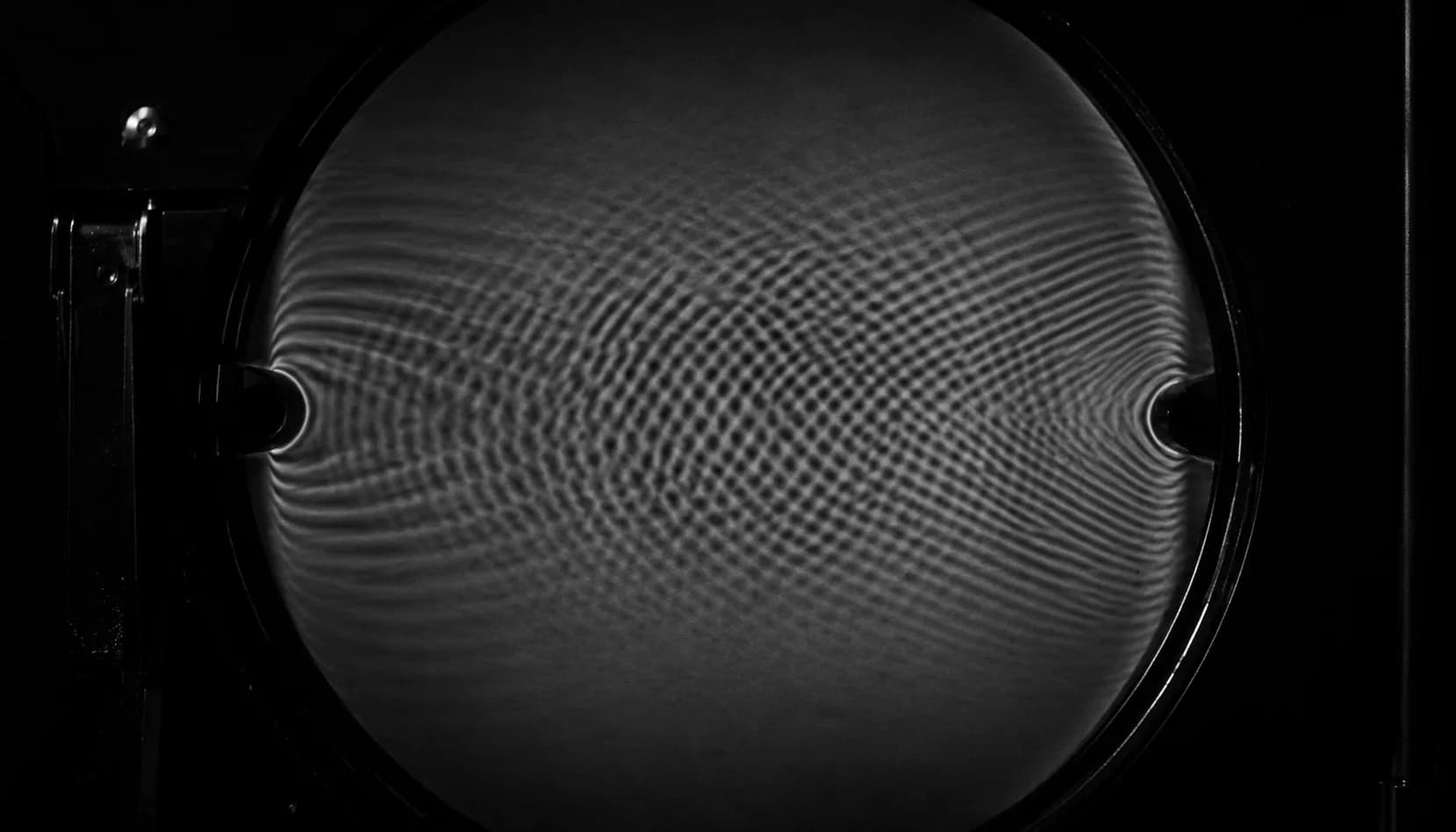
INPSN does not observe environments through lenses, pixels, or optical imaging. It perceives through time, distance, and distortion, using ultra-wideband (UWB) micro-burst pulses to continuously sense how space itself is behaving.
Where conventional surveillance systems rely on visual fields, INPSN operates through a pulse-based spatial perception model: brief, ultra-low-power emission bursts propagate through the environment, interact with physical forms, and return as complex reflection patterns. These reflections are interpreted as field distortions, not images, forming the raw perception basis from which INPSN derives spatial motion intelligence.

Ultra-Wideband Micro-Burst Doctrine
Each INPSN anchor emits carefully timed, nanosecond-scale UWB micro-bursts that illuminate the surrounding environment with an extremely short-duty, wideband pulse envelope. Rather than transmitting a continuous carrier or narrowband tone, anchors emit:
- Short-duration, wideband bursts designed for precision ranging and environmental sampling
- Ultra-low effective radiated power, operating well within recognized safety envelopes for built environments
- Controlled duty cycles, where the “on-air” time of each pulse sequence remains a tiny fraction of system uptime
These micro-bursts are not used to form pictures or identify individuals. They serve as timing and reflection probes, establishing how long it takes for energy to travel through space, encounter objects, and return to anchor reception paths. The result is a high-fidelity, non-visual understanding of distance, density, and motion behaviour within the protected environment.

Propagation, Reflection & Occlusion Behaviour
When a micro-burst propagates through a space, several key physical behaviours are observed:
- Direct path components travel along the shortest available path between anchor and environment surfaces
- Reflected components bounce from walls, floors, ceilings, structural elements, fixtures, and objects
- Occlusion effects occur where human bodies, equipment, furnishings, or crowd formations partially or fully interrupt line-of-travel paths
INPSN does not attempt to reconstruct the exact visual appearance of these surfaces. Instead, it continuously samples how pulse energy:
- Arrives earlier or later than expected
- Returns with stronger or weaker intensity
- Exhibits shifts in multipath patterning
- Shows region-specific attenuation or shadowing
These changes are interpreted as spatial occlusions and field distortions: physical evidence that something has entered, moved within, or altered the geometry of the space.
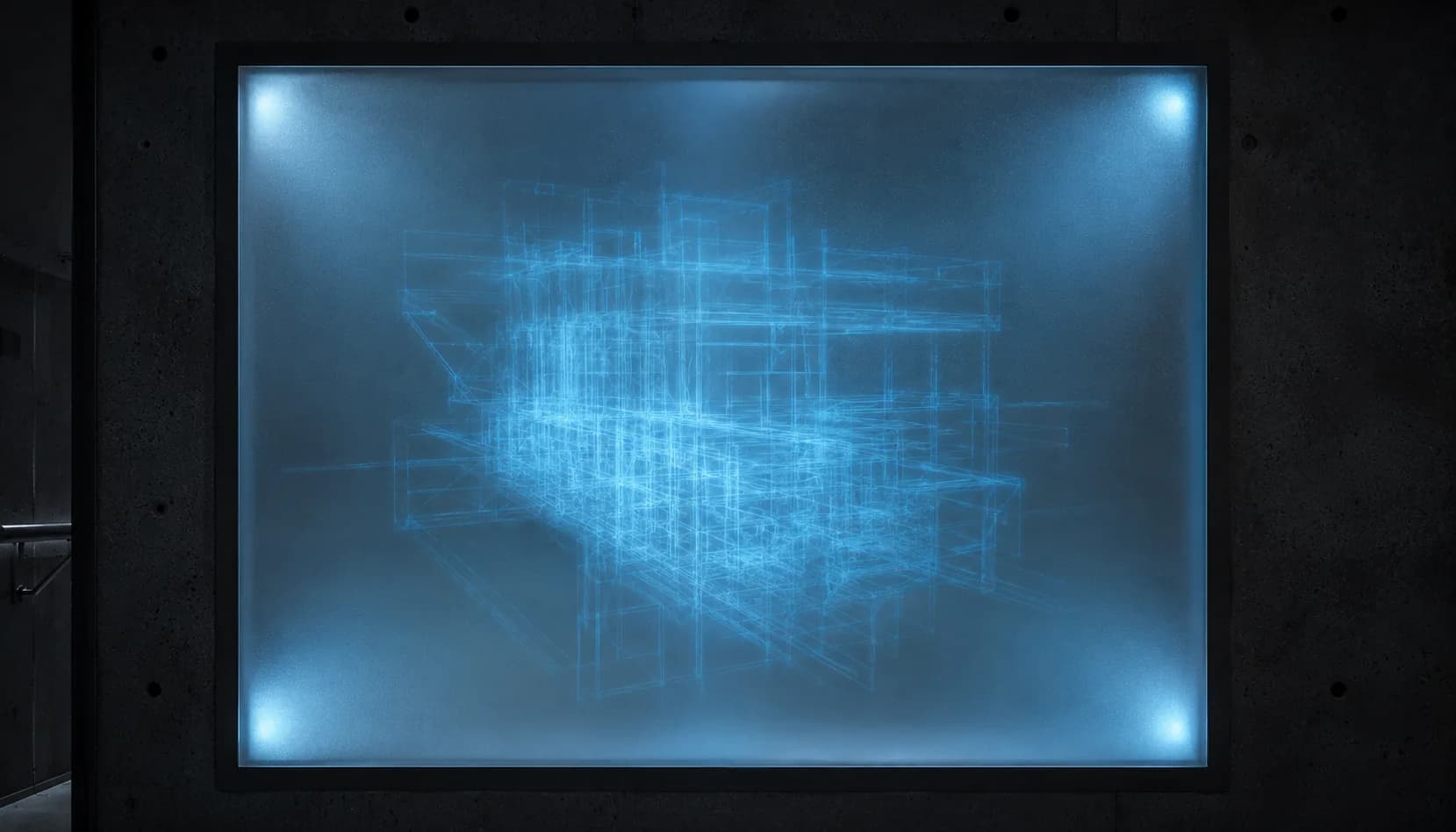
Over time, the system forms a stable understanding of baseline propagation for each venue. Any departure from that baseline, a person entering a corridor, a crowd forming in a plaza, an object being moved into a previously open area, manifests as a measurable change in the returning micro-burst distortion signature.
Temporal Sampling & Motion Sensitivity
Perception in INPSN is not a single snapshot, it is a continuous temporal sampling stream.
Anchors emit micro-bursts and receive reflections in precisely orchestrated time windows, allowing the system to observe:
- How the distortion pattern evolves from one sampling cycle to the next
- Where occlusion zones appear, strengthen, weaken, or vanish
- How edges of obstruction move through space over time
By comparing successive sampling intervals, INPSN becomes highly sensitive to:
- Micro-movements, small posture shifts, step transitions, or object nudges
- Macro-movements, walking, running, crowd flows, directional shifts
- Formation changes, groups forming, compressing, dispersing, or stagnating
- Area transitions, motion entering or exiting specific zones, corridors, or vertical stacks
The system does not need to “see” facial features or identities; it reads the temporal evolution of field distortion as evidence of motion, position change, and structural usage.

From Distortion Fields to Spatial Awareness
The micro-burst perception layer produces a continuous stream of time-resolved propagation signatures for every monitored zone. Within each zone, the system understands:
- The expected clean propagation profile under normal conditions
- The current observed distortion field produced by people, objects, and environmental changes
By comparing these, INPSN identifies:
- Where energy is being blocked or redirected
- How much signal change is occurring across specific volumes
- In which direction obstruction boundaries are moving over time
This does not yet produce named objects or tagged individuals. At this stage, INPSN is constructing a physics-level understanding of:
- Filled vs unfilled volumes
- Stable vs unstable propagation zones
- Emerging vs receding occlusion edges
These distortion maps are then supplied as abstraction layers into the geometry reconstruction stage (Section 3.5), where they are translated into live 3D motion geometry and, subsequently, into digital-twin visualizations and Behavioural Inference Engine (BIE) inputs.

Non-Visual, Non-Biometric Perception Model
Critically, the micro-burst perception physics layer:
- Does not generate optical imagery
- Does not capture facial features or personal appearance
- Does not process biometric identifiers
All perception is based exclusively on:
- Time-of-flight characteristics
- Signal strength and attenuation behaviour
- Multipath and occlusion pattern evolution
Human presence is therefore modeled as regions of structured distortion in the propagation field, not as identifiable individuals. This allows INPSN to deliver high-sensitivity motion intelligence while maintaining a non-biometric, non-visual spatial intelligence design, privacy-preserving safety doctrine.
(Comprehensive privacy and lawful surveillance compliance framing is detailed in separate legal and governance sections of the INPSN doctrine.)

Safety Envelope & Duty-Cycle Principles (High-Level)
INPSN’s micro-burst emissions are engineered to operate within strictly controlled safety envelopes suitable for continuous installation in human-occupied environments.
At a high level, the system adheres to the following principles:
- Ultra-low effective power, emissions are calibrated to remain well below commonly encountered RF levels in typical commercial, industrial, and residential environments
- Duty-cycle minimization, pulse activity occupies a very small fraction of any given time window, significantly reducing average exposure
- Spatial distribution, power is distributed across multiple anchors and directions, preventing concentration into singular high-exposure beams
- Standards alignment, emission envelopes are engineered to be compatible with recognized RF safety frameworks for building-scale infrastructure
Detailed Specific Absorption Rate (SAR) modelling, standards references, and regulatory compliance mappings are reserved for Section 3.10: Safety Physics & RF Compliance and related legal documentation, ensuring that public doctrine remains high-level while full engineering evidence is available under appropriate due-diligence channels.

NDA-Protected Physical Parameters
To protect INPSN from reverse-engineering, adversarial modelling, and infrastructure targeting, several underlying micro-burst parameters are deliberately withheld from public documentation and disclosed only under controlled NDA and security-cleared review.
These include, but are not limited to:
- Exact operating bands and sub-band allocation strategies
- Pulse width profiles, repetition rates, and timing sequences
- Detailed emission power envelopes and per-anchor duty-cycle metrics
- Anchor-to-anchor synchronization protocols and timing tolerances
- Fine-grained propagation tuning values for highly reflective or metallic environments
- Internal field-distortion interpretation models and weighting coefficients
This controlled opacity ensures that:
- Clients, regulators, and institutional partners can understand how INPSN perceives environments conceptually, while
- The precise physical and algorithmic parameters that make this perception uniquely reliable, safe, and defence-aligned remain protected from hostile replication or exploitation.
Organizations requiring deeper technical disclosures may request structured briefings under formal NDA and security screening, where extended engineering details can be shared in a controlled manner without compromising the sovereign safety posture of INPSN deployments.
This page describes system doctrine, operational intent, and safety governance. Technical parameters, implementation details, and operational thresholds are restricted and disclosed only under contractual NDA.