LIVE COMMAND VISUALISATION
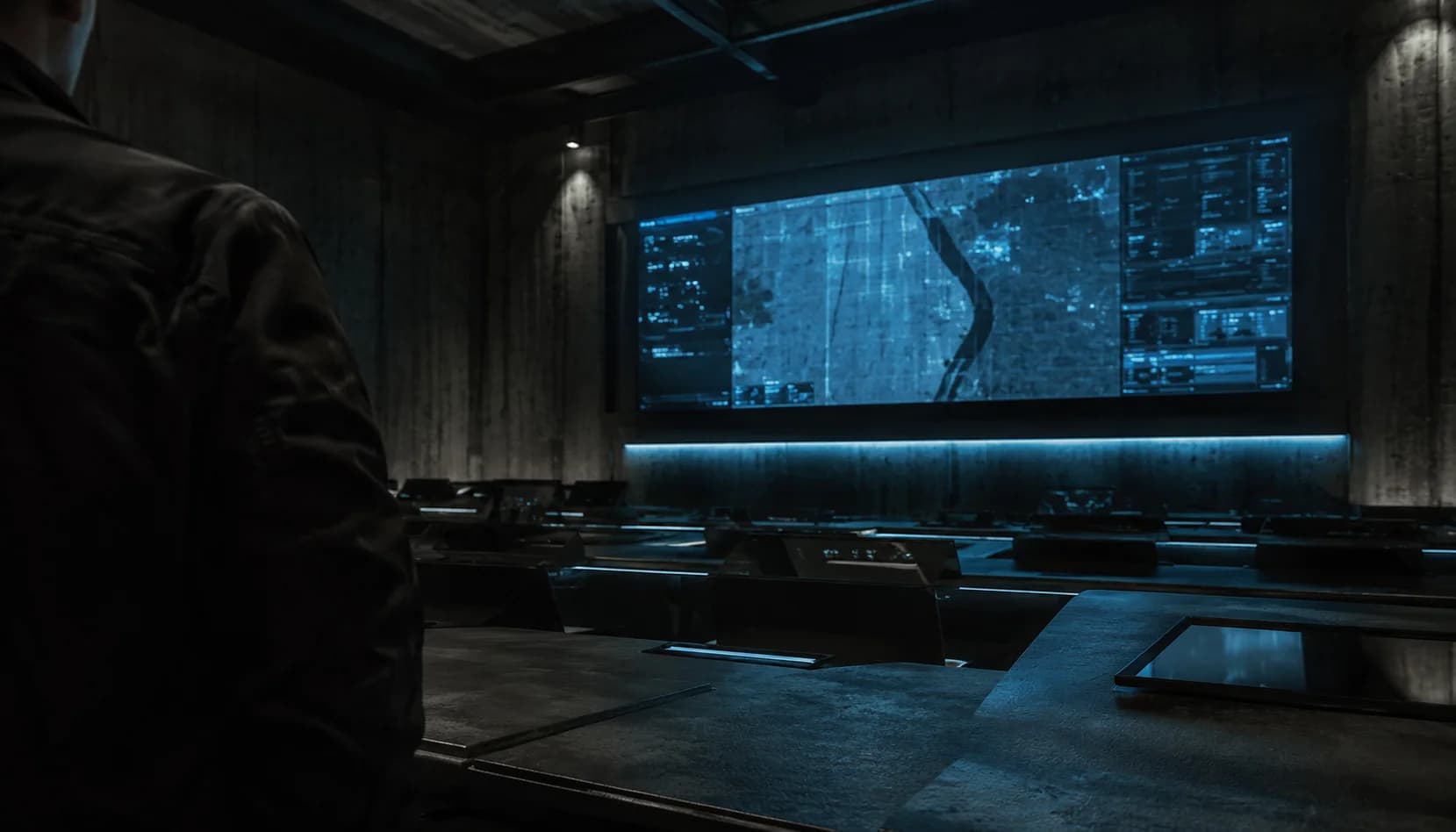
INPSN’s Live Command Visualisation Layer is the environment in which spatial cognition becomes operational authority. Here, the system’s frequency-derived motion intelligence, behavioural interpretations, and geometric reconstructions merge into a unified 3D/360° command space accessible to authorized leadership across mobile, tablet, laptop, command room consoles, and secure remote interfaces. This layer allows the estate’s owner, supervisors, and designated command personnel to perceive the premises as an active spatial theatre, one where every movement, environmental deviation, and behavioural signature is expressed as anonymised geometric intelligence anchored within the Digital Twin.
The purpose of this layer is not visual entertainment, nor camera-derived corroboration. It exists to give decision-makers a sovereign operational perspective grounded in spatial truth: the ability to understand how the environment is behaving, how individuals and groups are interacting with it, and how potential risk patterns are evolving. Because INPSN reconstructs human forms through anonymised geometric abstraction, where body posture, movement vectors, and simplified facial orientation cues appear without identity, the system ensures full operational clarity without any biometric exposure.
Across complex estates, multi-floor buildings, crowded public environments, and high-security infrastructures, this live visualisation becomes the cognitive bridge between perception and action. Through real-time command access, authorized users observe and govern the estate with precision, irrespective of their physical location, land, sea, or air, provided they possess valid credentials and secure connectivity.
Real-Time 3D/360° Operational Theatre
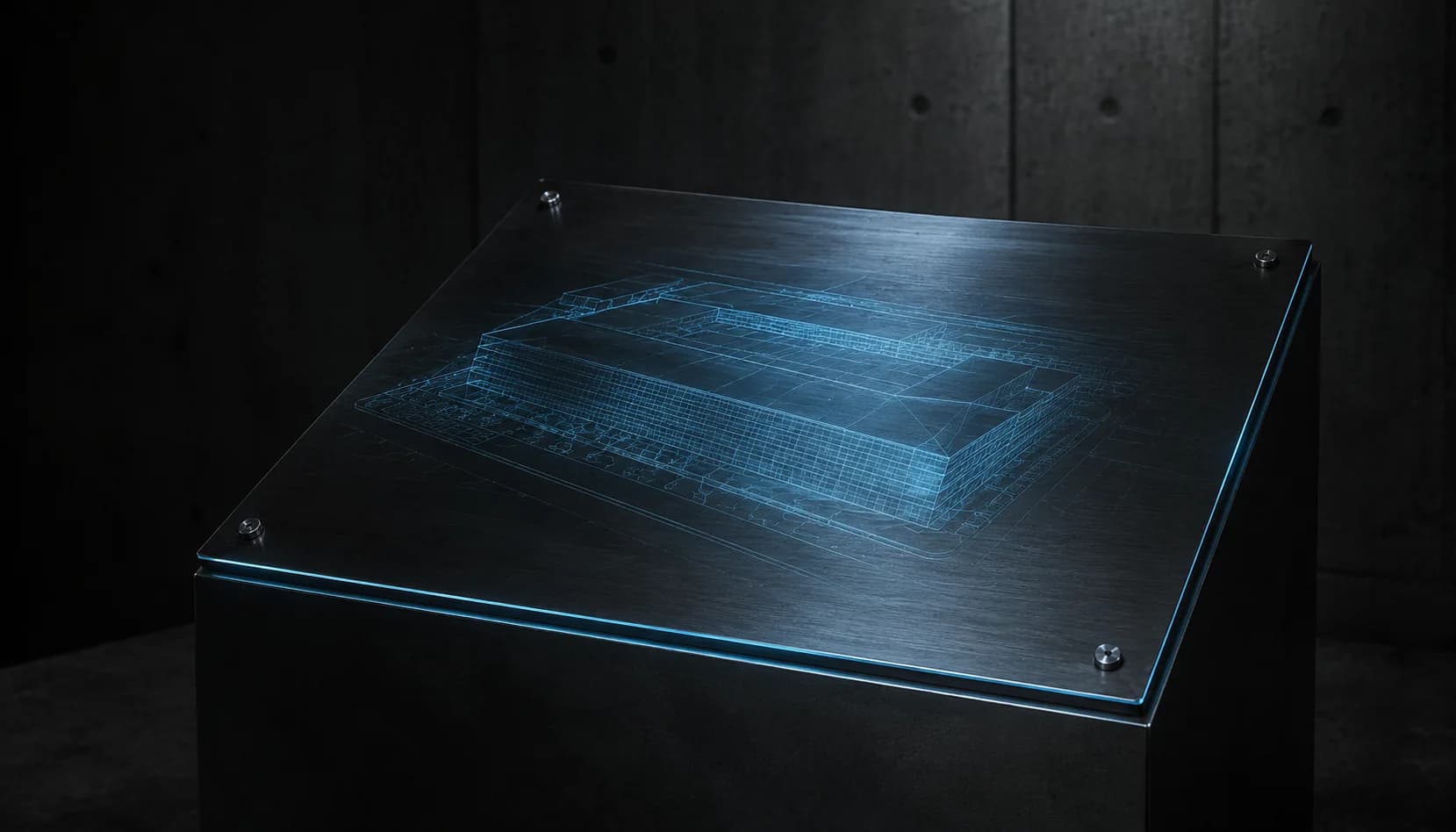
INPSN renders the entire premises in a continuously updating 3D/360° spatial theatre. Every floor, corridor, staircase, vertical shaft, open area, and secure zone is observable as a navigable model, synchronized to the frequency mesh. Live posture transitions, group formations, object disturbances, congestion signatures, and environmental anomalies materialize within this view as dynamic geometric entities. Human figures retain simplified facial orientation geometry only to clarify posture and direction, without generating any identifiable facial features, texture, or biometric mapping.
This environment allows operators to interpret spatial dynamics with forensic clarity. They may rotate the building, isolate a floor, view an entire structure with “no-walls” compositing, or examine a specific room, pathway, or crowd cluster at any scale. The system’s rendering engine preserves geometric fidelity even under high-density activity, ensuring that operational understanding is governed so that it does not deteriorate in complex or high-traffic conditions.
Real-time visualisation ensures that command personnel receive continuous situational awareness, enabling them to respond to emerging conditions before they escalate. Whether observing a lone individual deviating from expected pathways or evaluating the early compression signatures of a forming crowd, decision-makers experience the estate as a live cognitive environment rather than a passive map.

Multi-Device Spatial Command Access
Command access is distributed across mobile, tablet, laptop, and dedicated control-center consoles, each calibrated to the hierarchy established by the client. Owners retain absolute visibility and override authority. Supervisors receive tiered access reflecting their operational jurisdiction. Floor-level supervisors may be restricted to specific wings or levels, while enterprise-level command personnel may receive full-site access. This hierarchical visibility ensures that every action, whether corroboration, approval, or intervention, operates under structured institutional governance.
Regardless of device, the visualisation preserves full 3D/360° rotational control, allowing zoom, pan, orientation shift, and structural breakdown views. Mobile and tablet interfaces are optimised for field supervisors, enabling them to observe live spatial states while deployed across the estate. Laptop and command-center versions expand into multi-window operational layouts suitable for complex estates and multi-building oversight.
The continuity of access ensures seamless operational control. A client travelling internationally may view the entire estate, examine incident zones, approve or override MYTHIC advisories, or review historic events, all from secure remote access, without compromising the estate’s sovereignty.
Time-Indexed Replay & Investigatory Reconstruction
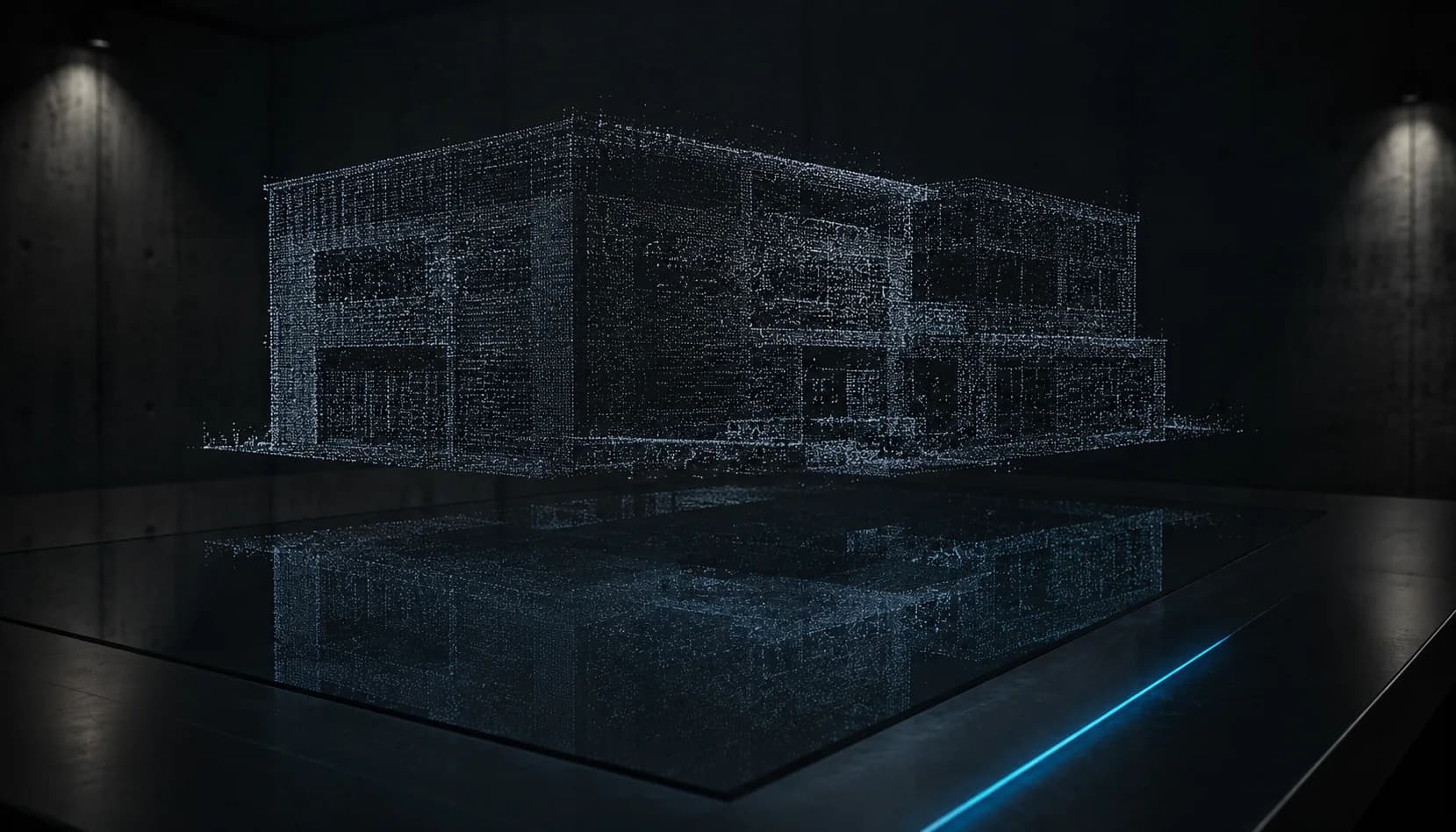
INPSN preserves an evidentiary-grade archive of all spatial states. Through time-indexed replay, authorized users may traverse past events with the same 3D/360° fidelity available in live view. This includes geometric posture reconstruction, environmental overlays, crowd-path evolution, object disturbance sequences, and behavioural signature transitions.
Replay operates like temporal navigation: authorized users may drag through timelines, shift to specific timestamps, jump to incident markers, or conduct slow-motion or fast-forward analysis. Floors may be isolated to reconstruct vertical transitions; entire buildings may be examined in unified view; environmental overlays may be applied for enhanced clarity. This temporal reconstruction functions as an investigative instrument suitable for insurance verification, internal audit, operational review, and lawful authority engagement.
Through anonymised geometric reconstruction, featuring simplified orientation cues but no identifiable appearance, the replay environment remains entirely privacy-compliant while offering high-fidelity behavioural clarity.
Command Action & Operator Governance
Live visualisation is not passive. Command personnel may directly interact with the environment, selecting guards, issuing redeployment commands, marking zones, approving MYTHIC advisories, or overriding autonomous workflows. The drag-and-drop command layer allows supervisors and owners to reposition personnel, define temporary operational zones, or initiate standard operating procedures in response to observed conditions.
Every action taken through the visualisation interface is logged with temporal precision. This includes guard movements, response timelines, escalation actions, and decision approvals. The record becomes an immutable operational ledger aligned with the estate’s governance structure.
Through this layer, spatial cognition becomes spatial authority. Operators do not observe; they govern.
NDA-Bound Engineering Architecture
The underlying mechanisms that synchronize frequency-derived reconstruction, geometric rendering, behavioural overlays, and command interactivity operate through proprietary arbitration frameworks, interpolation rules, and cognitive synchronisation protocols. These remain reserved for enterprise clients under NDA.
Such disclosures permit due diligence while protecting the core intellectual architecture that enables INPSN to operate as a sovereign spatial-intelligence system rather than a visualisation tool.
This page describes system doctrine, operational intent, and safety governance. Technical parameters, implementation details, and operational thresholds are restricted and disclosed only under contractual NDA.