PHYSICAL DETECTION LAYER: THE UWB ANCHOR NODES
INPSN’s spatial intelligence begins with a distributed layer of UWB anchor nodes, fixed, defence-aligned detection units that form the physical backbone of the frequency mesh.
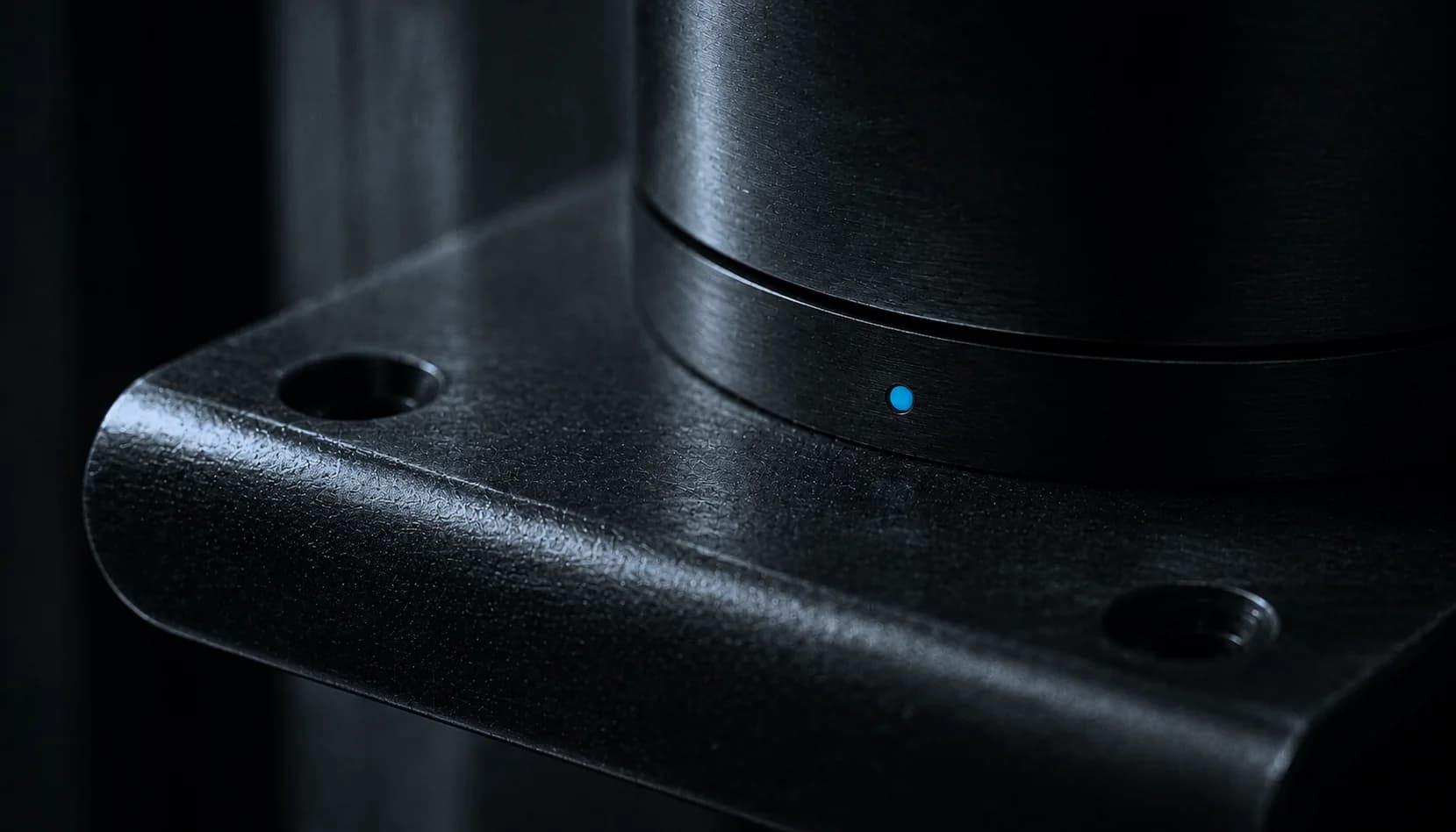
INPSN’s spatial intelligence begins with a distributed layer of UWB anchor nodes, fixed, defence-aligned detection units that form the physical backbone of the frequency mesh. These anchors are not cameras, microphones, or biometric probes; they are precision-engineered instruments whose sole function is to emit and receive controlled ultra-wideband (UWB) micro-bursts for spatial motion perception within defined safety envelopes.
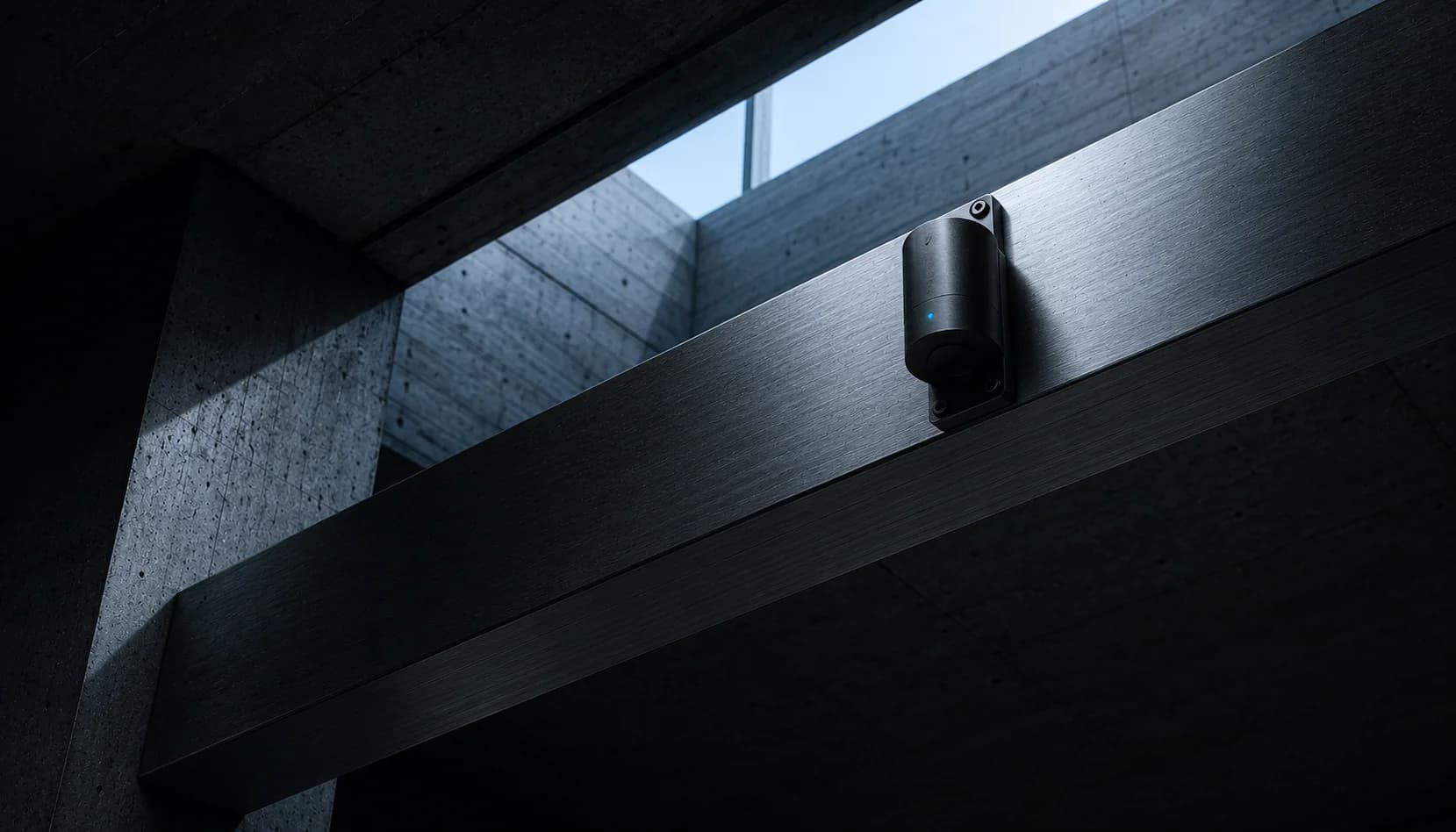
Each anchor is designed as a discreet architectural element rather than a visible surveillance device. In deployed environments, anchors are typically mounted along ceiling lines, structural beams, upper wall bands, or perimeter support points, using non-invasive mounting systems that respect existing finishes, structural tolerances, and fire-safety regulations wherever site conditions permit.
Once installed, anchors visually recede into the architecture, functioning as silent spatial reference points that structure the INPSN grid, not as focal objects on the premises.

Form Factor & Architectural Neutrality
UWB anchors are specified to maintain:
- Compact, low-profile housings that blend into commercial, industrial, governmental, and luxury residential interiors.
- Architectural neutrality, avoiding aggressive or tactical aesthetics that may disrupt design language or create psychological discomfort in public or executive spaces.
- No exposed optics or visible recording elements, reinforcing that these are non-image, non-audio sensing devices.
- Static, solid-state construction with no moving parts, minimizing maintenance, vibration sensitivity, and mechanical wear.
Where necessary, custom shrouds, color-matched housings, or integrated panels may be used to merge anchors into ceiling grids, soffits, or structural features, preserving both design intent and operational coverage.
Installation Doctrine & Coverage Philosophy
Anchors are deployed according to a coverage doctrine rather than a consumer-style “device-per-room” model. INPSNuses anchors to establish spatial reference geometry, not to “watch” individual locations in isolation.
Without disclosing deployment densities, the doctrine ensures:
- Ceiling and upper-perimeter anchoring to maximize line-of-sight into open volumes and circulation spaces.
- Grid continuity across critical corridors, lobby volumes, atriums, stair cores, and transitional spaces, ensuring spatial perception does not break at chokepoints.
- Outdoor and semi-outdoor integration (entry plazas, drop-offs, loading bays, perimeters) where safety and flow operational review is required.
- Structured vertical continuity, ensuring that stairs, lifts, and landing zones remain perceptible as movement transitions between floors.
Mounting practices are designed to be non-destructive wherever possible, making use of:
- Existing mounting interfaces and architectural frames
- Approved drilling and fastener locations where required
- Fire-rated and compliant materials in regulated environments
The result is a physical detection layer that occupies the premises with minimal visual footprint, while still enabling continuous 3D motion sensing across the full operational domain.

Power, Stability & Redundancy Behaviour
UWB anchors operate on stabilized low-voltage power integrated into the approved electrical framework of the site. They are not high-draw devices and are engineered to remain ultra-low power relative to conventional building loads.
Key principles:
- Buffered power stabilization may be deployed where specified, smoothing voltage fluctuations and supporting graceful degradation strategies.
- Anchors operate under strict duty-cycle governance, transmitting nanosecond-scale UWB bursts in short, controlled intervals, not continuous high-energy emissions.
- Local mesh redundancy is designed so that if a single node is impaired, spatial coverage degrades gracefully, rather than failing catastrophically.
- In power-loss scenarios, predefined fail-safety behaviour and event logging ensure that operational gaps are known, time-indexed, and auditable.
No public documentation discloses:
- Exact per-anchor power consumption
- Per-acre or per-floor anchor counts
- Circuit layouts or detailed electrical topologies
Those remain restricted to under-NDA engineering documentation only.

Signal-Only Perception Principle
Anchors form the first and only physical sensing layer in INPSN. They:
- Emit ultra-low-power UWB micro-bursts into space
- Receive returning patterns as those pulses propagate, reflect, and are subtly obstructed
- Provide raw field-interaction data for subsequent geometry and motion reconstruction
They do not:
- Capture imagery or video
- Record audio
- Scan faces, bodies, or biometric signatures
- Operate as radar export platforms or open RF probes
All perception is based solely on how frequency fields behave when they encounter structure, objects, and movement.
From this layer, higher systems convert signal behaviour → spatial geometry → motion intelligence, but no personal identity information is ever collected at the anchor level.
Material & Environmental Adaptation (High-Level)
Because real estates include glass, metal, concrete, composites, and reflective surfaces, INPSN anchors participate in an adaptive spatial calibration process during commissioning:
- Mesh tuning routines adjust anchor coordination to account for known reflective structures (steel, glass walls, metallic frames).
- Continuity strategies ensure that stairs, elevators, and transitional structures do not create blind tunnels in spatial perception.
- Environmental baselines are recorded so that subsequent deviations in movement and blockage patterns can be distinguished from structural effects.
At the public doctrine level, this is expressed only as adaptive frequency-correction and mesh-stabilization behaviour, without exposing underlying algorithms, equations, or propagation models.
Service-Governed Infrastructure, Not Standalone Hardware
INPSN anchors are not a consumer product and not a self-install kit.
They are deployed as part of a governed safety infrastructure service, which includes:
- Design, survey, and installation under NeuraLoop or certified partner supervision
- Integration into the frequency mesh, digital twin, BIE, MYTHIC, and NII command stack
- Ongoing calibration, operational review, security hardening, and performance validation
Hardware on its own does not constitute INPSN; it becomes meaningful only as part of the full institutional safety architecture, including governance, command hierarchy, legal compliance, and operational doctrine.
This page describes system doctrine, operational intent, and safety governance. Technical parameters, implementation details, and operational thresholds are restricted and disclosed only under contractual NDA.